Web3 Beginner Series: The Web3 Wallet I'm Still Using in 2025
As an important gateway to the blockchain ecosystem, wallets in recent years in the Web3 industry seem to no longer be the main narrative of Web3. This phenomenon stems both from the market's focus shifting to the AI track and from the lack of breakthrough innovative products in the wallet sector. For most users, wallets are regarded as infrastructure-like existence: when interacting with the Ethereum ecosystem they use MetaMask, and when interacting with the Solana ecosystem they choose Phantom. This tacit understanding has become an industry norm, but it seems to be only that.
However, upon closer observation, it becomes apparent that mainstream wallets in the past few years in fact carry out a large number of innovations and upgrades. For example, MetaMask implements login via third-party social accounts such as Google and Apple, and expands support to non-EVM ecosystem chains such as Bitcoin and Solana; Phantom evolves from a Solana-native wallet into a multichain wallet, supporting the Ethereum mainnet and multiple L2s, as well as public chains such as Bitcoin and Sui…
In addition, security issues always remain at the core of wallet product iteration. The frequent incidents of private-key theft change users' psychological expectations of self-custody security, pushing wallet products to seek a new balance between security and usability. People increasingly find that full self-custody may be highly idealized, especially for wallets that interact frequently with DApps. As a result, from complex seed-phrase management to streamlined social logins, and from single-chain support to full-chain interoperability, the ongoing evolution of wallet products is reshaping the way users interact with blockchains.
MetaMask: Social Login and Multichain Expansion
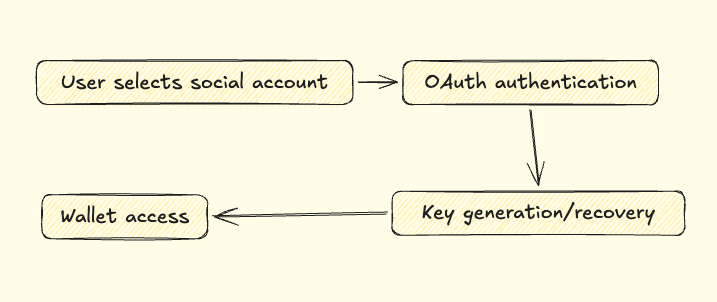
First is MetaMask (https://metamask.io/). As an iconic wallet of the Ethereum ecosystem, its changes to some extent can be regarded as a wind vane for the wallet sector. Its social login feature represents a breakthrough in the traditional wallet experience. Based on the TOPRF (Threshold Oblivious Pseudorandom Function) cryptographic primitive, MetaMask implements identity verification via a Google or Apple account while preserving the core characteristics of a non-custodial wallet. This technical approach splits the private key into multiple encrypted shards and stores them in a distributed manner; only through dual verification—social authentication and an independent security password set by the user—can the complete private key be reconstructed.
At the architectural level, MetaMask first achieves support for non-EVM ecosystems through the Snaps extension system. As pluggable modules, Snaps allow developers to create customized support for different blockchains, transforming MetaMask from a purely Ethereum wallet into a true multichain gateway. This architectural design both preserves core security and leaves room for future expansion. Unfortunately, since its launch, Snaps remains somewhat lukewarm. And this year, MetaMask goes further by offering native multichain support, currently taking the lead in natively supporting Solana and Bitcoin SegWit addresses.
Phantom: A Versatile Wallet Originating from Solana
Phantom (https://phantom.com/) wallet's development trajectory reflects the rapid growth of the Solana ecosystem. Initially as a Solana-native wallet, Phantom quickly gains market recognition thanks to its smooth user experience and deep support for NFTs. In 2023, Phantom officially supports the Ethereum mainnet, marking its strategic shift toward a multichain wallet.
Just like Solana's rapid development, Phantom also adds new features very quickly. It is now possible to buy perpetual contracts directly within the wallet and trade directly on prediction markets. This seems to be a trend across the entire internet industry: service providers always want users to stay longer inside their own apps.
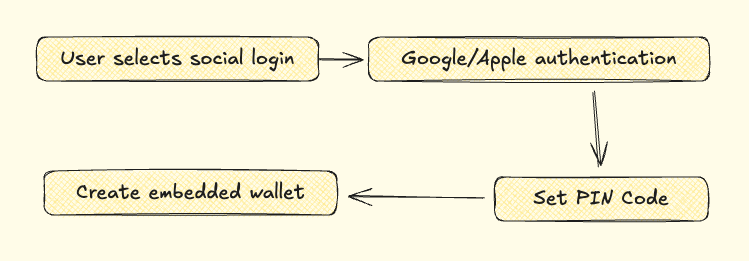
In terms of user experience, Phantom's social login adopts a distinctive PIN mechanism. After completing authentication via a Google or Apple account, users need to set a PIN as a local verification credential. This design strikes a balance between security and usability—the PIN is easier to remember than a traditional seed phrase while providing an additional security layer. Through its Phantom Connect technology, Phantom provides developers with an authentication SDK, allowing applications to automatically create embedded wallets for users while remaining compatible with existing Phantom wallet users. The cross-device sync feature allows users to access their wallets seamlessly across different devices, further improving convenience.
TipLink: Links That Are Money
TipLink (https://tiplink.io/) is a major innovation in the Web3 interaction paradigm. According to its official documentation, TipLink's core concept is "Links that are money". Its workflow is extremely simple: users connect a crypto wallet to create a TipLink and deposit funds, generate a unique URL or QR code to share with the recipient, and the recipient can claim and use these funds even if they do not have a crypto wallet.
This design completely removes the onboarding barrier of traditional wallets. Recipients do not need to understand concepts such as private keys, seed phrases, or gas fees; they only need to click the link to complete claiming the funds. TipLink's innovative value lies in redefining the concept of a "wallet"—it is no longer a tool that users must actively create and manage, but an asset container that can be passively received and used. This model is particularly suitable for high-frequency, lightweight use cases such as small payments, tipping, and gifts, providing new possibilities for the mass adoption of Web3.
New Wallets
Although the wallet sector is already quite entrenched, new players are still joining.
The TopNod (https://topnod.com/) wallet further segments the Web3 wallet market. According to its official website, it is a decentralized self-custodial wallet focused on real-world assets (RWAs), and TopNod's core positioning is to connect Web3 with traditional financial markets. It supports the tokenization of mainstream financial assets such as gold, U.S. Treasuries, and U.S. stocks, providing users with the ability to view, store, and transfer cross-chain RWA tokens.
In terms of security, TopNod adopts enterprise-grade standards, including multiple protection mechanisms such as AES-256 encryption, TEE (Trusted Execution Environment) protection, encrypted access-code sharding, and secure memory confinement. Traditional finance–grade security principles and compliance standards give it a unique advantage in RWA policy-making and cooperation with financial institutions.
Summary
Wallets may no longer be the hottest narrative focus in Web3, but their importance as infrastructure never diminishes. As AI and blockchain technologies further converge, wallet products continue to innovate in areas such as identity management, asset automation, and cross-chain interoperability. As the industry's focus shifts among different tracks, wallets, as the bridge connecting users to the blockchain world, continue to evolve and lay the foundation for the next wave of mass adoption.
About ZAN
As a technology brand of Ant Digital Technologies for Web3 products and services, ZAN provides rich and reliable services for business innovations and a development platform for Web3 endeavors.
The ZAN product family includes ZAN Node Service, ZAN ZK Acceleration, ZAN Smart Contract Audit (AI Scan/Expert Audit), with more products in the pipeline.