Web3 Beginner Series: System Challenge, ZAN Response: How RPC Providers Handle Ethereum's Fusaka Upgrade

Introduction: Systemic Upgrades as the Ultimate Test for Web3 Infrastructure
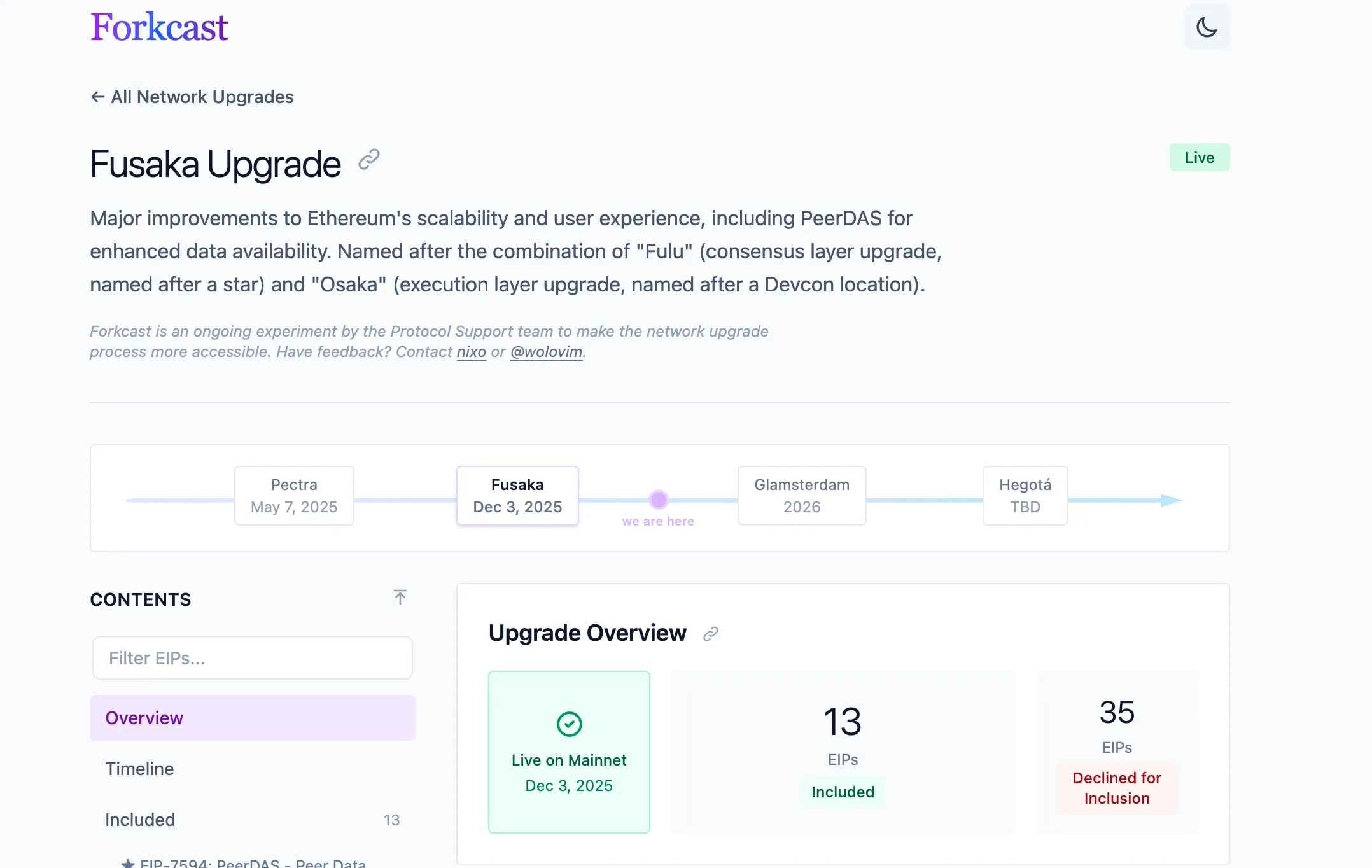
Each milestone Ethereum network upgrade (https://ethereum.org/zh/roadmap/)—from "The Merge" and the "Dencun" upgrade to the latest Fusaka upgrade on December 4, 2025—has been a comprehensive "stress test" for Web3 infrastructure providers. As the core hub connecting developers, applications, and blockchain networks, RPC node providers are the key players in this hard-fought upgrade battle.
The core goal of the Fusaka upgrade is to reshape Ethereum's data availability architecture by introducing breakthrough technologies such as PeerDAS (EIP-7594), clearing the way for large-scale expansion of Layer 2 (L2) networks. For professional RPC infrastructure providers like ZAN Cloud, this is by no means a simple software version iteration, but a triple test of forward-looking monitoring capabilities, phased deployment capabilities, and cross-ecosystem collaboration capabilities.
As the "infrastructure guardian" of the Web3 ecosystem, ZAN Cloud understands that the stability and timeliness of RPC services are the lifeline for developer innovation and application deployment. This article will provide an in-depth breakdown of ZAN Cloud's end-to-end response plan, revealing how we leverage technical strength to safeguard the Fusaka upgrade, ensuring node services remain stable and reliable at all times, and building a solid foundational support for Web3 developers worldwide.
Forward-Looking Monitoring—Capturing Upgrade Signals End-to-End to Achieve "Foresight"
The success of a large-scale network upgrade begins with millisecond-level responsiveness to technical developments. ZAN Cloud has built a multi-layered, automated monitoring and alerting system to ensure that every upgrade signal—from code commits to community consensus—is captured with precision.
1. GitHub Tracking: Full-Lifecycle Monitoring of Multi-Client Release Versions
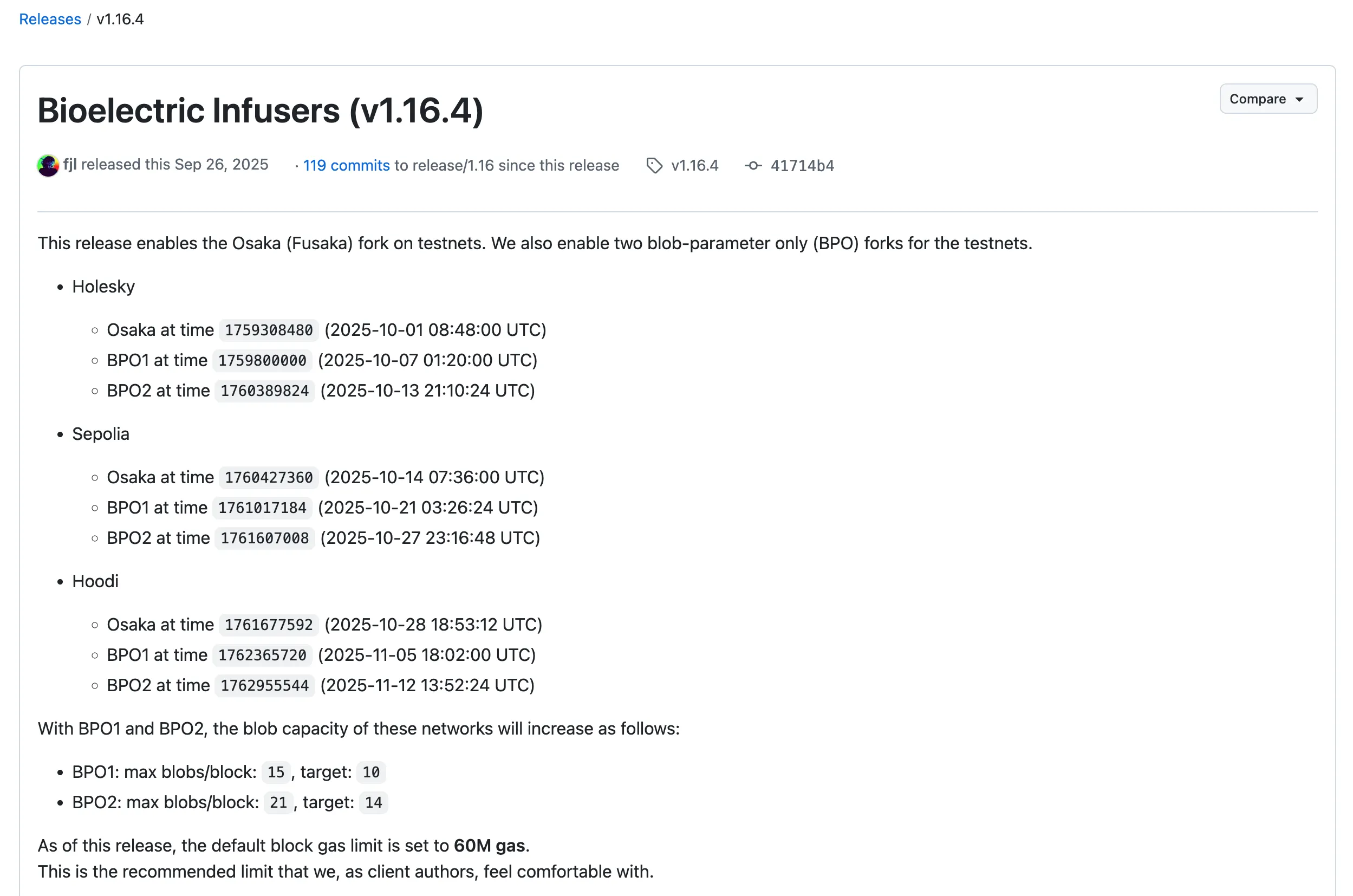
Ethereum's core clients (execution clients: Geth, Reth; consensus clients: Lighthouse, etc.) are the primary carriers for upgrade implementation. Real-time control of their version dynamics is the first step in handling an upgrade. ZAN Cloud's engineering team has set up a customized automated monitoring toolchain to enable full-process technical tracking:
- Real-time release alerts: Continuously monitor the official GitHub repositories of major clients. Once a
Pre-releasetest version or aLateststable release tag is detected, the system immediately triggers multi-level internal alerts and automatically pulls the release package to perform preliminary code-level compatibility analysis.
2. Community Engagement: Cross-Validating Across Multiple Channels to Ensure Accurate Information
The technical details and timelines of blockchain upgrades are often born out of public discussions within the community. ZAN Cloud is not only a receiver of technical information, but also a deeply engaged participant in Ethereum's core community:
- Full follow-through on core meetings: The engineering team regularly tracks meeting notes and public discussions from the Ethereum Dev community, gaining first-hand access to the latest decisions on upgrade proposals, phased timelines, and potential technical risks, ensuring our understanding of the upgrade path stays aligned with core developers.
- Cross-validation from multiple information sources: By subscribing to official updates from the Ethereum Foundation Blog and joining core developer Discord groups, among other channels, we cross-verify upgrade details to eliminate misjudgments that could arise from relying on a single source, ensuring our upgrade preparation stays on the right track.
3. Internal Health Monitoring: Dual Validation of Versions and Interfaces
Alongside external monitoring, ZAN Cloud leverages its internal automated operations platform to build a health and compatibility monitoring system for node clusters:
- Real-time visualization of version distribution: By integrating Prometheus and Grafana to build monitoring dashboards, we display in real time the client types and version distribution ratios of nodes across the entire network, ensuring that during the upgrade process, node version iteration progress is clearly visible and under control.
- Proactive interface compatibility testing: For new features introduced in the Fusaka upgrade, we prepare comprehensive test cases in advance covering all scenarios, and conduct continuous stress testing and compatibility validation of the JSON-RPC interfaces of new client versions, ensuring that after the upgrade, existing Web3 applications will not be affected in their normal calls.
Phased Deployment—From Testnets to Mainnet, Advancing Step by Step to Reduce Risk
In the face of a systemic upgrade like Fusaka, ZAN Cloud strictly follows the deployment principles of "test first, then mainnet; small traffic, then full rollout; canary release with rollback," minimizing upgrade risks and ensuring service continuity.
1. Early Battle Preparation: Meeting the Performance Challenges of "Super Nodes"
While the PeerDAS mechanism in the Fusaka upgrade enhances L2 data availability, it also places higher demands on the storage and bandwidth performance of RPC nodes—RPC providers must take on the role of "Super Nodes," storing and processing the full set of Ethereum Layer 1 (L1) data. To this end, ZAN Cloud planned ahead and made thorough preparations:
- Forward-looking expansion of hardware resources: Based on estimations of PeerDAS data traffic, we planned and deployed high-spec storage servers and high-bandwidth network resources in advance, ensuring nodes can handle the post-upgrade surge in data volume with ease.
- Deep tuning of node configurations: The engineering team performed in-depth optimization of node runtime parameters based on the characteristics of the new client versions. By adjusting memory allocation, data caching strategies, and more, we ensure low latency and high throughput for RPC requests under high-load scenarios.
2. Phased Implementation: Testnets First, Smooth Transition to Mainnet
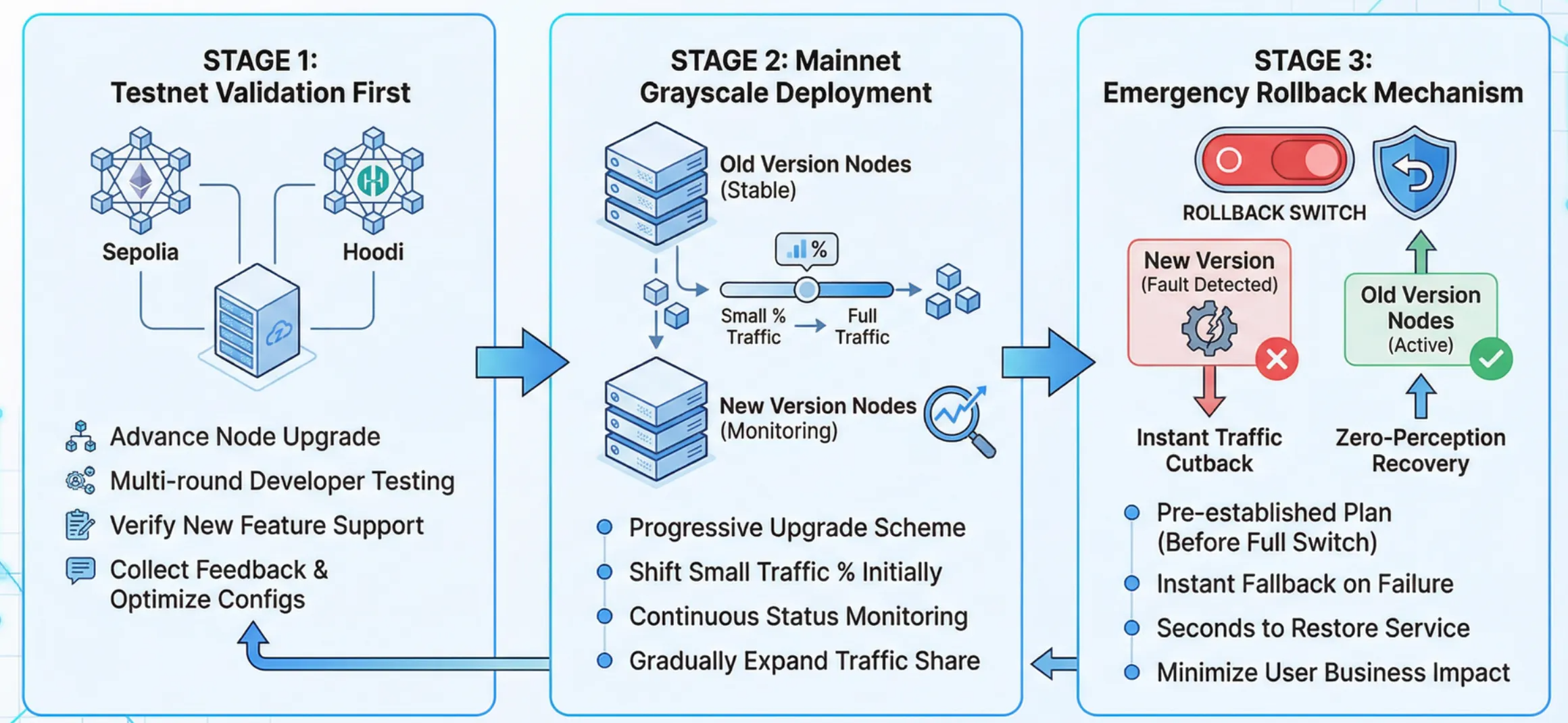
The core of upgrade deployment is "progressive implementation." ZAN Cloud has formulated a clear phased execution plan:
- Testnets first for validation: Before the upgrade windows open on Ethereum testnets such as Sepolia and Hoodi, we complete node version upgrades in advance and work with developers through multiple rounds of testing to verify node support for new features, while also collecting feedback to optimize node configurations.
- Mainnet canary deployment: During the mainnet upgrade window, we adopt a gradual upgrade approach—first switching a small proportion of user traffic to the new-version nodes and continuously monitoring their operating status; once all metrics remain stable, we then gradually increase the traffic share until a full cutover is completed.
- Emergency rollback mechanism: Before the full cutover, we establish a comprehensive rollback plan. If unforeseen technical failures occur in the new version, we can switch all traffic back to the old-version nodes within seconds, achieving "zero-perception" fault recovery and minimizing the impact on users' business to the greatest extent possible.
Ecosystem Collaboration—Coordinated Support for Layer 2 Networks to Achieve End-to-End Compatibility
An upgrade to Ethereum L1 will inevitably trigger chain reactions across L2 networks. As an RPC provider covering mainstream L2 networks, ZAN Cloud has always regarded coordinated L1–L2 upgrades as core work, ensuring seamless connectivity across the entire ecosystem.
1. Deep Collaboration with L2 Teams to Synchronize Adaptation Progress
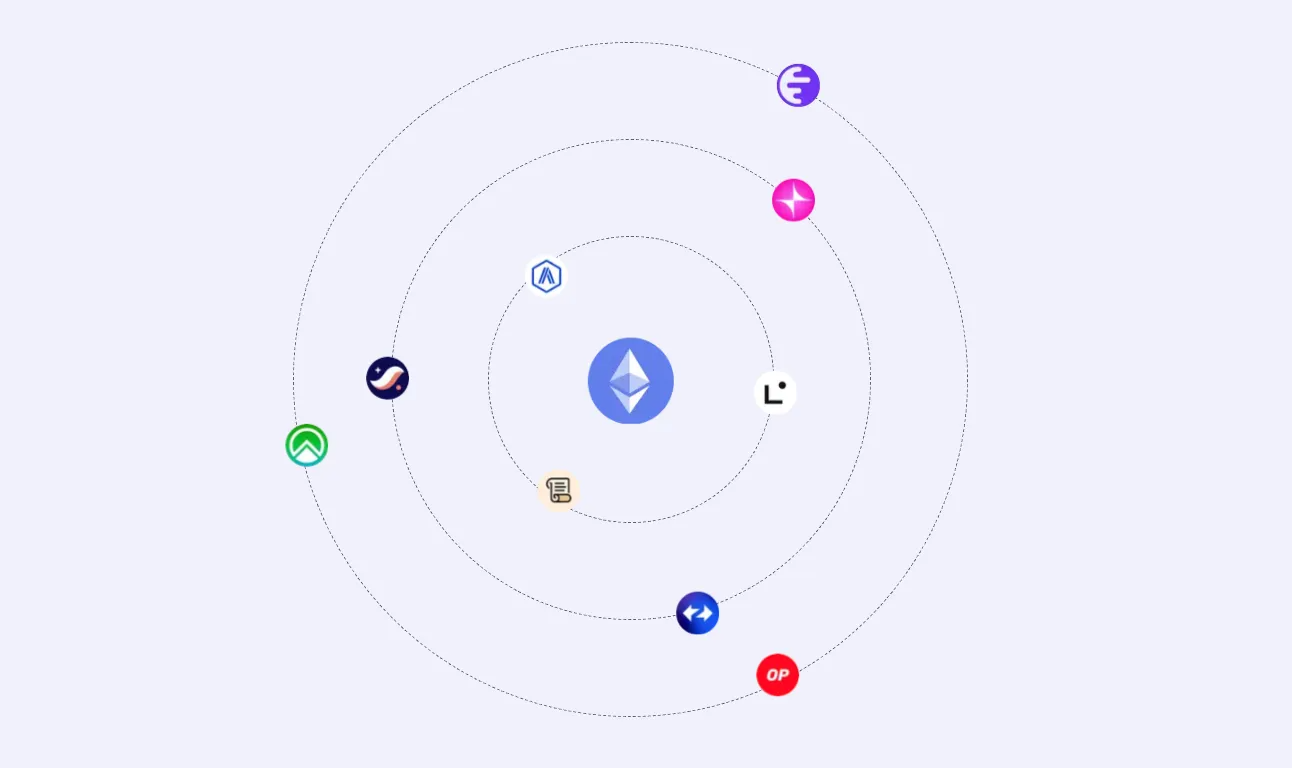
ZAN Cloud has established a regular communication mechanism with mainstream L2 teams such as Jovay, Arbitrum, Optimism, and Base:
- Track in real time each L2 network's adaptation plan for the Fusaka upgrade and its version release progress, obtaining L2 node upgrade requirements and technical parameters in advance.
- For the customized needs of L2 networks, adjust RPC node configuration strategies to ensure compatibility between L1 and L2 node versions, avoiding data transmission interruptions caused by version mismatches.
2. Focusing on Blob Data Flows to Ensure Core L2 Functionality
After the Fusaka upgrade, L2 transaction data will be submitted to L1 via a brand-new Blob mechanism, which is critical to the normal operation of L2 networks. ZAN Cloud focuses on the following work:
- Conduct dedicated tests on the Blob data processing capabilities of upgraded L1 nodes to verify whether nodes can correctly receive, store, and query Blob data.
- For the core needs of L2 sequencers and provers, optimize the efficiency of Blob data retrieval via RPC interfaces to ensure that L2 transaction finalization and data availability are not affected.
3. Coordinated Upgrades for Multi-Chain Services to Achieve Full Ecosystem Coverage
Leveraging its multi-chain RPC service architecture, ZAN Cloud extends its Fusaka upgrade response plan across the entire ecosystem:
- Treat the upgrades of L1 and each L2 network as a coordinated project, and develop a unified upgrade timeline to ensure that nodes across all relevant networks complete iterations within compatible time windows.
- After the upgrade is completed, perform end-to-end testing of the full RPC service pipeline, covering all scenarios such as transaction queries and contract calls from L1 to L2, ensuring a consistent service experience for users in a multi-chain environment.
Conclusion: ZAN Cloud—Your Trusted Web3 Infrastructure Partner
The Ethereum Fusaka upgrade is a major challenge of the technical strength and service capabilities of Web3 infrastructure providers. As an industry-leading RPC node provider, ZAN Cloud has always taken "forward-looking planning, phased implementation, and full-ecosystem collaboration" as its core principles, calmly responding to every systemic challenge.
From GitHub code tracking to assessing community consensus, from testnet validation to progressive upgrade deployment, and from L1 node upgrades to L2 ecosystem coordination, ZAN Cloud ensures 99.9% high availability of node services with a standardized, automated, and refined end-to-end solution.
Looking ahead, ZAN Cloud will continue to deepen its focus on the Web3 infrastructure domain, keep pace with upgrades across Ethereum and the broader multi-chain ecosystem, and safeguard global developers and application teams with professional technical capabilities and reliable service quality. Choosing ZAN Cloud means choosing stable, efficient, future-ready Web3 infrastructure assurance.
About ZAN
As a technology brand of Ant Digital Technologies for Web3 products and services, ZAN provides rich and reliable services for business innovations and a development platform for Web3 endeavors.
The ZAN product family includes ZAN Node Service, ZAN ZK Acceleration, ZAN Smart Contract Audit (AI Scan/Expert Audit), with more products in the pipeline.